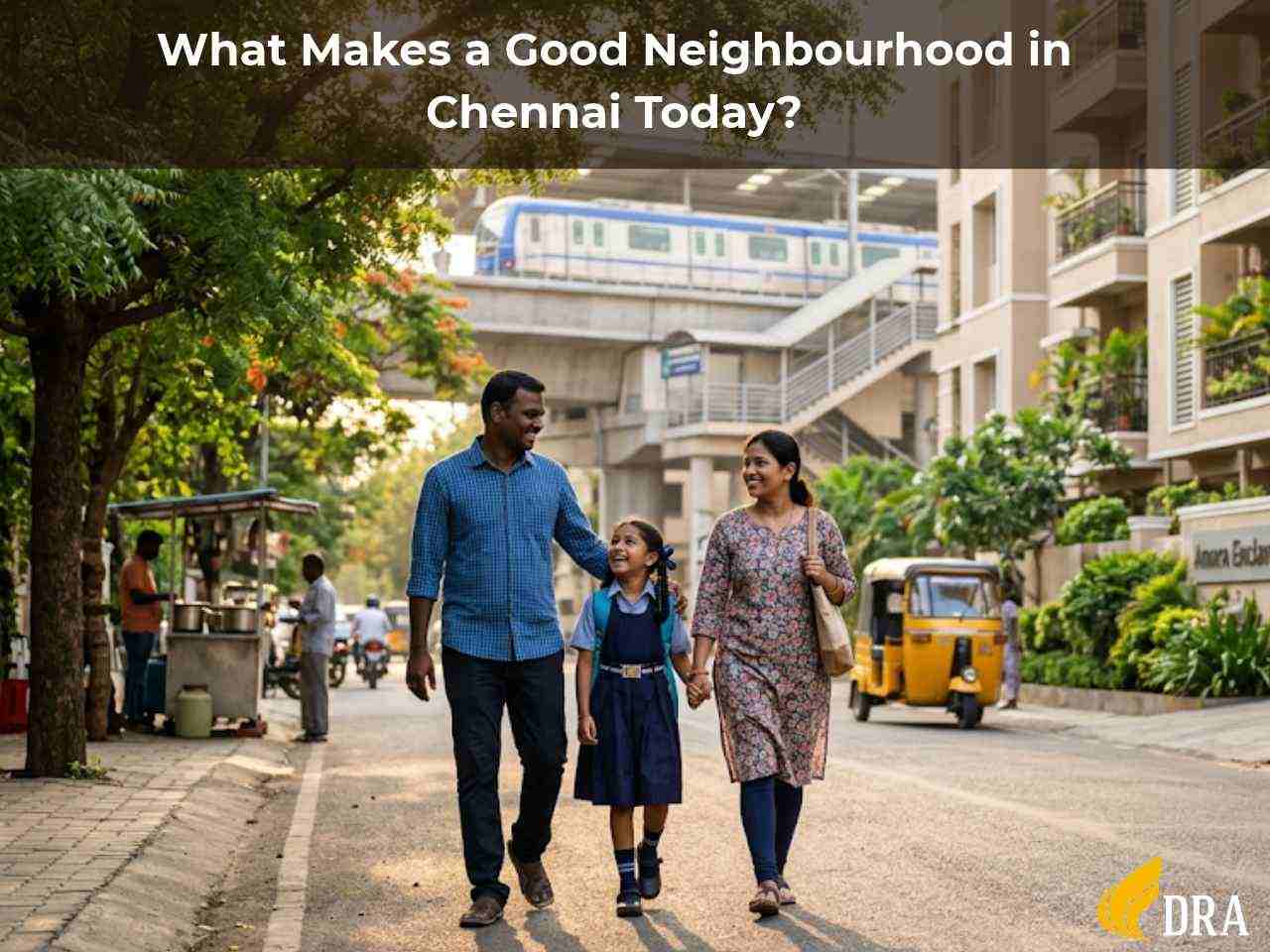
Ask a Chennai family from the 1990s to name a good neighbourhood, and you would hear the same few names: Anna Nagar, Adyar, Mylapore, T. Nagar. A respected pin code was the whole answer.
Ask a homebuyer the same question in 2026 and the answer starts with a different set of questions. How long is the drive to work? Does the street flood in November? Is there a metro station I can walk to? Will the water supply hold up in May?
The idea of a good neighbourhood in Chennai has not disappeared. It has simply been redefined, and the buyers redefining it are making some very practical choices.
Quick answer: A good neighbourhood in Chennai today is one that makes daily life easier, not just one with a famous name. Buyers now judge an area by commute time, metro and road access, water and drainage planning, nearby schools and hospitals, and how the locality is expected to grow over the next ten years.
For decades, a "good area" meant three things: a central location, an established community and a name that impressed relatives. Those things still matter. But they no longer answer the questions that shape everyday life.
Several changes have pushed buyers to think differently:
The buyers we meet at DRA Homes site visits rarely start with the pin code. Their questions sound more like a practical checklist.
A 25 km home with a 40-minute metro ride often beats a 10 km home stuck behind two signals and a flyover under construction. Buyers now measure a neighbourhood in minutes, not kilometres.
Metro connectivity is changing how homebuyers look at West Chennai. With Chennai Metro Phase II expanding towards Poonamallee, areas like Porur, Kattupakkam and Iyyappanthangal are gaining attention for their improving public transport access. The corridor is expected to make travel to key parts of Chennai more convenient, giving homebuyers another reason to consider neighbourhoods that once felt too far from the city.
Chennai buyers have learnt this the hard way. A good neighbourhood today is one where the roads clear quickly after heavy rain and where water supply does not depend on tankers every summer.
Schools, hospitals, supermarkets and a decent evening walk within 10 to 15 minutes. Families with ageing parents care about this as much as young couples care about the office commute.
Buyers are cautious about hype. They want to see infrastructure that is already open or under visible construction. If you want a structured way to judge this, read our guide on how to evaluate neighbourhood growth in Chennai without price hype.
| What buyers valued earlier | What buyers value in 2026 |
|---|---|
| A famous, established address | Short, predictable commute time |
| Closeness to the city centre | Closeness to metro, ring roads and workplaces |
| Independent houses and plots | Planned gated communities with shared amenities |
| Social prestige | Water security and flood resilience |
| Mature, fully built-out areas | Areas with visible, funded infrastructure growth |
| Price paid per sq.ft | Value received per sq.ft: space, light, ventilation |
The new definition is not pulling buyers to random suburbs. It is pulling them towards areas where connectivity, planning and liveability come together.
West Chennai is a clear example of this shift. Arcot Road neighbourhoods like Valasaravakkam combine an established residential character with access to schools, hospitals and nearby hubs such as Porur and Vadapalani. Further west, improved Metro connectivity is changing how homebuyers view properties near Poonamallee, turning what once felt like a distant location into a more accessible residential option.
The Chennai Peripheral Ring Road is another major infrastructure project influencing how buyers view the city's expanding residential areas. With different sections at various stages of development, the project is expected to strengthen connections between Chennai's suburbs and industrial corridors. Buyers should, however, verify the status of the specific road section relevant to their location.
In the south, buyers are choosing quieter, greener pockets that still connect easily to GST Road and the Velachery side. East Tambaram is a good example, with neighbourhoods around Selaiyur and Madambakkam drawing families who want calm streets without losing city access. Projects like DRA Beena Clover in East Tambaram, which is IGBC Gold Pre-Certified, reflect how sustainable design is becoming part of what buyers look for in a modern residential community.
Also read: Valasaravakkam vs Porur: Where Should You Buy a Flat in Chennai?
Before shortlisting a locality, here are six things worth checking in person.
The meaning of a good neighbourhood in Chennai has moved from status to substance. A famous address is still valuable, but it is no longer the only route to a good life in the city.
Today's smartest buyers are choosing homes where the commute is shorter, the water is reliable, the drainage is planned and the area has real, visible growth ahead of it. Often, that home is a few kilometres beyond the names our parents knew.
At DRA Homes, we plan our projects around these everyday realities, because a good neighbourhood is ultimately the one that makes your life easier every single day.
Looking for a home in a neighbourhood that works for the way you live now? Talk to our team and schedule a site visit.


 Link Copied!