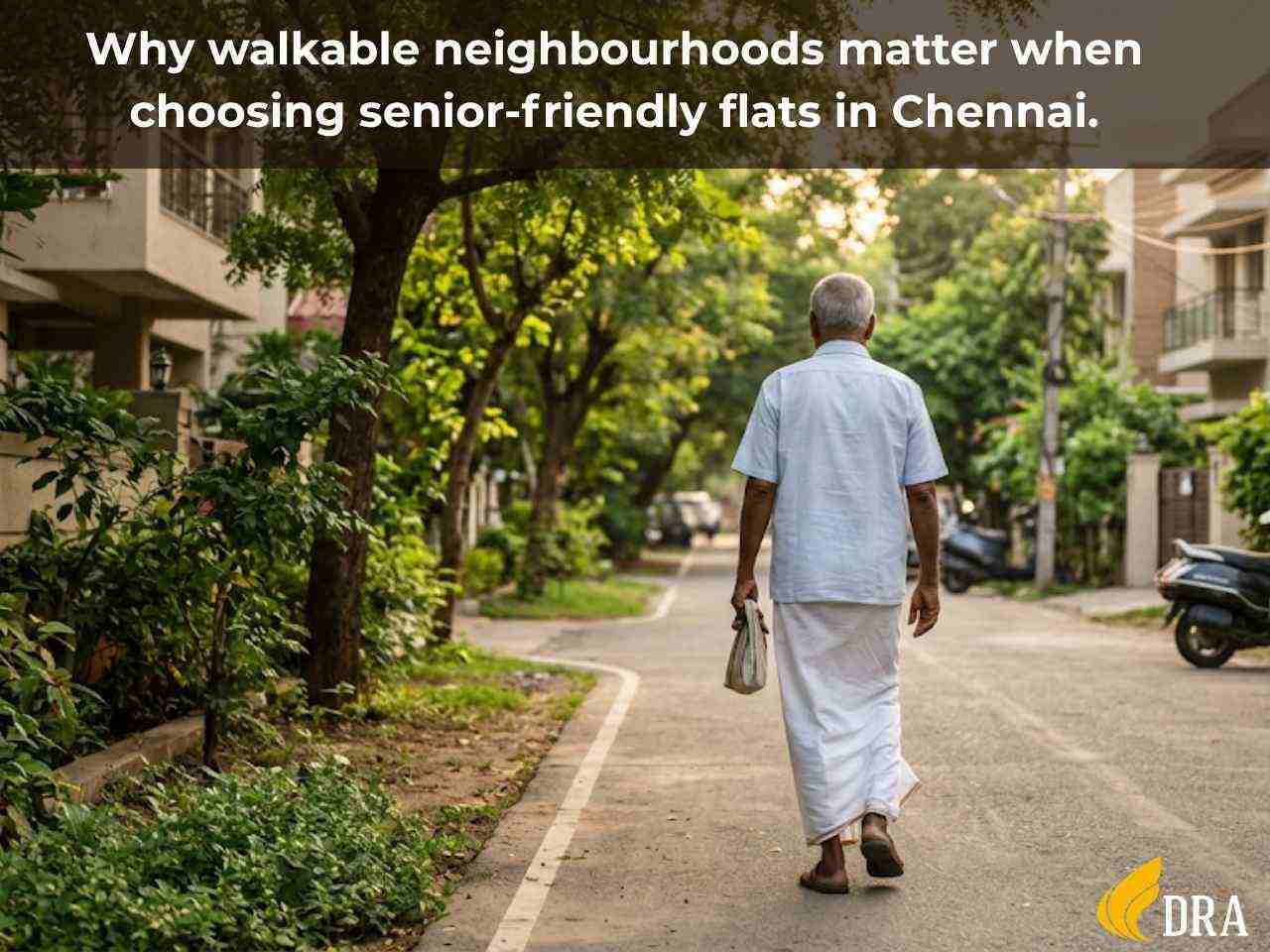
In many Chennai households, mornings begin with familiar routines for the elderly. They may have a quick visit to the bank planned, a few medicines to pick up, or groceries to buy from their regular shop. These may seem like small errands, but being able to manage them independently matters.
Whether these outings are a comfortable walk or require someone to arrange a ride has very little to do with the apartment itself. It depends on what lies around it.
When families compare properties in Chennai for senior citizens, the conversation usually turns to lifts, ramps and anti-skid tiles. Those matter. But elders tend to judge a locality by a simpler measure: how many of their weekly errands they can finish on foot, on their own terms. We call this the independence radius.
A home that supports independence is not simply one that makes daily life easier indoors. It should also help elderly residents remain connected to the neighbourhood, maintain their routines and move around with confidence.
What is the independence radius?
It is the distance within which an elderly resident can comfortably walk to the places they use every week, such as the bank, pharmacy, post office, temple and vegetable shop. The safer and more accessible these everyday routes are, the easier it becomes for elderly residents to manage their routines without depending on others for transport.
There is no fixed distance that works for everyone. An elder's independence radius depends on their mobility, walking comfort, road conditions, available shade and the number of crossings along the way.
India's population is ageing, with southern states already recording a higher proportion of older residents than the national average. According to the UNFPA India Ageing Report 2023, people aged 60 and above are projected to account for more than 20% of India's population by 2050.
For many Chennai households, this is not a statistic. It is the reason a 3 BHK is on the shortlist instead of a 2 BHK, or the reason a son working on OMR is looking for a flat that suits his parents as well as his children.
As more families plan homes where multiple generations can live comfortably, choosing senior citizen-friendly apartments in Chennai requires looking beyond the apartment's layout. The surrounding neighbourhood can play an equally important role in helping elderly parents maintain their independence.
Before visiting any project, sit with your parents and list where they actually go in a normal week. For most Chennai elders, the list looks something like this:
This list becomes your measuring tape. A flat with a beautiful clubhouse but no pharmacy within walking reach may suit your weekend lifestyle, while making everyday errands more dependent on family members or transport arrangements.
The goal is not to have every service immediately outside the apartment gate. It is to understand which everyday journeys your parents can make comfortably, which require assistance and whether the neighbourhood supports the lifestyle they already enjoy.
A brochure map with circles marking "2 km to hospital" does not tell you whether an elder can walk there. Distance on a map and distance on foot are very different things in Chennai, where a 600-metre walk can include a broken footpath, a busy signal-free junction and no shade at all.
Do the bank walk at 10 am and the temple walk at 6 am or 6 pm, the hours your parents would actually go. If possible, take them along. Their pace, and where they stop to rest, is the real test.
Pay attention to how comfortable they feel during the journey rather than focusing only on how quickly they reach the destination. A route that feels manageable in the morning may become tiring during Chennai's hotter afternoon hours.
One controlled signal with a pedestrian phase is manageable. Two wide roads with fast traffic and no signal can turn a short errand into a daily risk. Note every crossing on the route.
Also check whether pedestrian signals allow enough time to cross comfortably. A crossing that feels easy for a younger adult may be difficult for someone who walks slowly or uses a walking aid.
Consider this hypothetical example of two apartments in Chennai. From the first, the nearest pharmacy is just 400 metres away, but reaching it requires crossing a busy road without a pedestrian signal. From the second, the pharmacy is 800 metres away, along a shaded route with a continuous footpath and safer crossings.
Although the first apartment is closer on paper, the second route may be more comfortable for an elderly resident who can manage the longer distance.
This is why the independence radius should be measured by the quality of the journey, not simply the number of metres shown on Google Maps
The walk starts at the flat's door, not the gate. Check the route from the lift to the lobby to the main gate. Are there steps without handrails, a steep ramp, or a gate that is heavy to open?
Also check whether the lifts have reliable power backup and whether common areas remain accessible during a power interruption. For elderly residents, these details can determine how confidently they move in and out of their homes.
If you are still deciding on the floor, our guide on which floor suits families with elderly parents covers that choice in detail.
Not every good home sits in an old, dense neighbourhood. Many newer residential projects in Chennai are in growing suburbs where shops and services are still filling in. That does not rule them out. It means looking at what bridges the gap.
Public transport within easy reach. A bus stop, metro station or suburban railway station near the property can extend the independence radius, provided the route to the stop or station is safe and accessible. Consider whether your parents can comfortably board, travel and return without assistance. Chennai's planned transport upgrades may change which localities qualify over the next few years, as we discussed in our article on how Chennai's new transport upgrades could change the way we choose homes.
Within-campus convenience. Some gated communities include a convenience store or space for one. Ask the developer what is planned, and whether it is confirmed or still an idea.
Social connection inside the community. Walking tracks, shaded seating and a place to meet other residents matter as much as any errand.
Healthcare access beyond walking distance. While a nearby pharmacy or clinic is useful for routine needs, families should also check access to hospitals and emergency medical services. A short distance alone does not guarantee a quick journey, particularly during peak traffic hours.
Also read: How Modern Apartments in Chennai Are Designed for Every Age
Take these to every site visit when you are comparing senior-friendly apartments in Chennai:
Ask for specific, documented answers. A clear response is a good sign. A vague one is worth noting.
A useful approach is to shortlist three everyday destinations that matter most to your parents and test the actual walking routes during the site visit. This can reveal more about their future daily routine than a long list of amenities in a brochure.
The right home for a family with elders is not just about the flat. It is about whether your parents can visit the bank, pick up their medicines and stop for a conversation at a familiar neighbourhood shop, without having to depend on someone else for every outing.
When you shortlist flats in Chennai for senior citizens, measure the walk as carefully as you measure the carpet area. The independence radius rarely appears in a brochure, but your parents will feel it every single day.
A home that supports independent living gives elderly parents something beyond convenience: the freedom to continue familiar routines, make everyday decisions and stay connected to the neighbourhood they call home.
If a DRA Homes project is on your shortlist, get in touch with our team to arrange a site visit with your parents. Explore the apartment, understand the surrounding neighbourhood and assess the nearby everyday conveniences together before making your decision.
Start with the neighbourhood. Check whether the bank, pharmacy, post office and place of worship are a safe, short walk away. Inside the project, look for lifts with power backup, ramps, handrails, well-lit common areas and shaded seating. Rather than choosing a floor based on height alone, consider lift reliability, emergency access and your parents' individual mobility needs.
It depends on the person's health, mobility, stamina and the conditions of the walking route. A 10 to 15-minute walk may be a useful starting point for some independently mobile elders, but it is not a universal recommendation. The quality of the footpath, availability of shade and number of road crossings matter as much as the distance itself. The best way to assess comfort is to walk the route with your parents at their usual pace.
No. Many elders live independently in regular apartments within family-friendly communities, especially when essential services are close by. Dedicated retirement communities offer added care services. The right choice depends on health needs, budget and whether the family wants to live together. For families planning multigenerational living, a regular apartment in an accessible neighbourhood may also be worth considering.
Not necessarily. Newer suburbs may have fewer shops within walking distance today, but accessible public transport, nearby healthcare facilities and useful on-site amenities can help support independent living. Visit with your parents, test the routes, and ask what is confirmed nearby rather than what is only planned. Prioritise facilities that are already available and usable, rather than depending entirely on future infrastructure promises.


 Link Copied!